
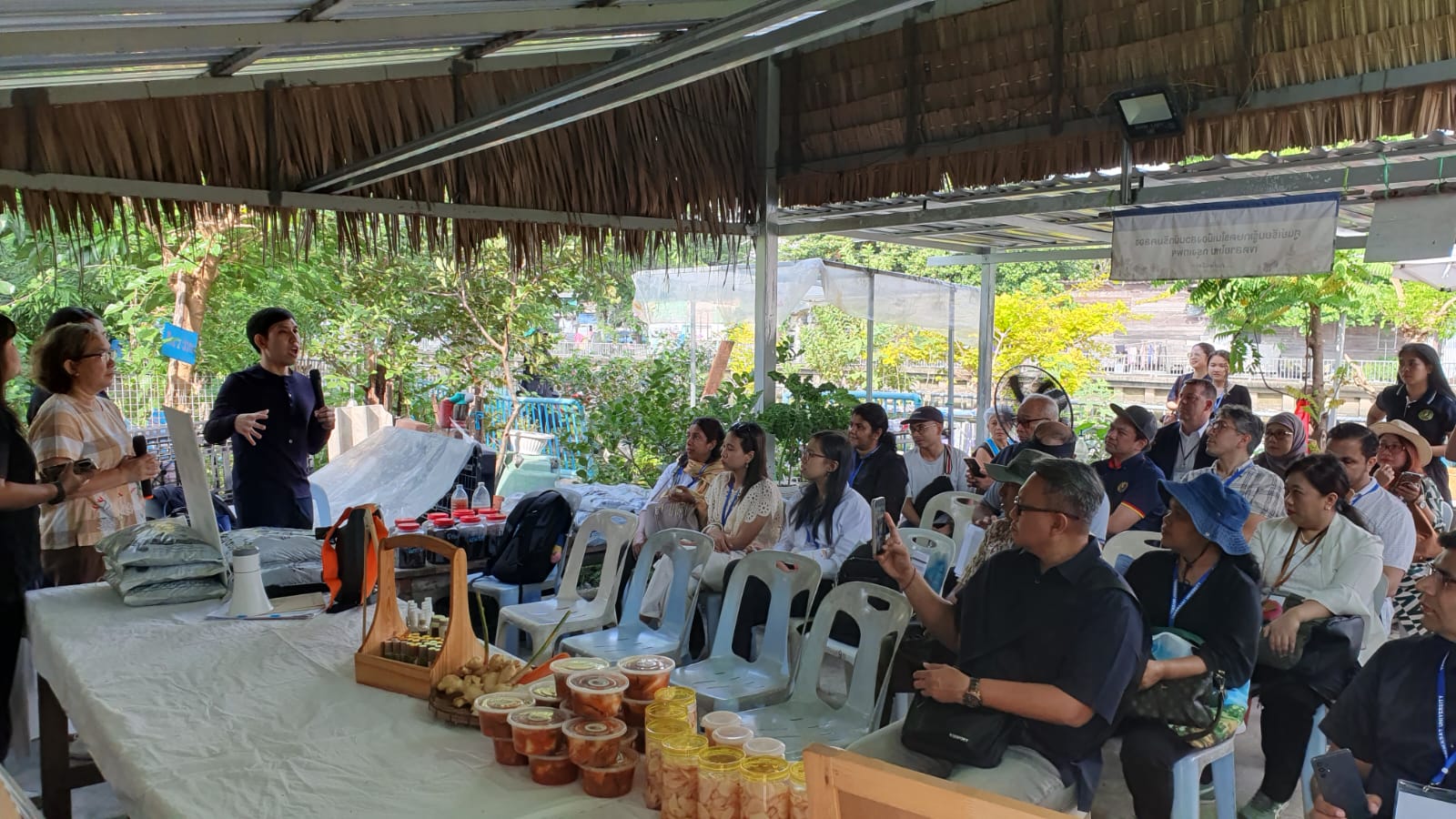
As part of the WUACD Executive Board Meeting 2025, hosted by Thammasat University, participants had the opportunity to visit one of Bangkok’s local communities, Baan Mankong, a canal-side community. The visit to the canal-side community became an essential part of the meeting since canal-side communities are an integral and deeply familiar part of Bangkok’s urban landscape which shapes the city’s identity long before modern development transformed its skyline. Bangkok grew around a vast network of khlongs that supported daily life, mobility, and commerce. Even today, neighbourhoods along these canals remain vibrant social ecosystems marked by strong communal ties, collective decision-making, and cultural continuity. Because these areas face complex challenges such as flooding, pollution, and land insecurity, safeguarding their well-being has become increasingly important, not only for reasons of equity but also for Bangkok’s long-term resilience. Supporting improvements to canal-side settlements strengthens environmental management, cultural preservation, and the city’s social fabric.

What stood out during the visit was the leadership: the community is led by a woman. Her role is not an exception, but rather common in this canal-side neighborhood, which demonstrates strong trust from residents, underscoring how women’s leadership can play a central part in community cohesion and sustainable urban living. Locals shared that they trust her judgment and value her commitment to representing and protecting their collective interests.

This moment resonated deeply with WUACD’s core mission to promote inclusive and equitable community development. The fact that a woman leads an entire canal-side community, historically vulnerable and often marginalized, highlights how gender-sensitive governance can be embedded in real-world community structures. It offers a powerful illustration that sustainable development is not just about infrastructure or housing, but about who defines and manages that development. The project of Baan Mangkong Canal Side project, as a community development initiative by one of WUACD partners, Thammasat University, supports the acceleration of SDGs 5: Gender Equality, which the program supports in ensuring women’s full and effective participation and equal opportunities for leadership at all levels of decision-making in political, economic, and public life. The support to the acceleration of SDGs 5 in Baan Mankong community goes beyond Thammasat University. Several WUACD partner institutions’ presence in the Executive Board Meeting demonstrated their strong commitment to promoting women’s leadership in community development namely Universitas Airlangga, Universiti Teknologi Malaysia, Federation University, University of Notre Dame Australia, UCSI, and Daffodil International University. By participating in the visit, participating institutions demonstrated that improving gender equality is a shared duty among WUACD member institutions, enhanced by collective learning and collaboration.

Besides that, for the WUACD Executive Board and participating delegates, the visit provided invaluable insights into how community-led initiatives can flourish when rooted in trust, cultural identity, and inclusive leadership. Witnessing firsthand how a female leader effectively harmonizes the needs and aspirations of Baan Mankong residents enabled participants to contemplate gender equality not merely as an abstract objective but as a tangible practice integrated into daily governance.

The experience further deepened their understanding of the urban resilience challenges faced by canal-side communities, including land insecurity, environmental hazards, and socio-economic vulnerabilities, while illustrating practical, community-based solutions that could be adapted or examined in greater depth in other countries. The visit broadened participants’ perspectives, reinforced their dedication to collaborative development strategies, and reaffirmed the vital role of academic institutions working closely with communities to realize sustainable and equitable progress. The visit underscored the urgency of scaling up similar participatory models elsewhere, empowering local leadership, prioritizing community voice, and embedding gender equality in development processes are not optional; they are essential foundations for sustainable, inclusive progress.
The 2025 Executive Board’s visit to the Baan Mankong community reaffirms WUACD’s commitment, underscoring that universities must not only produce knowledge but also stand with communities to promote equity, amplify the voices often unheard, and support sustainable transformation from within.
0 Comments